Sustainability
Sustainable office materials
In interior design, most of a project’s carbon footprint lies in what is manufactured, shipped and thrown away. That is why sustainability starts with materials. We choose low-impact finishes, sourced nearby, healthy for indoor air and built to last.
timeline: depends on floor
Is this your case?
- We have ESG commitments to our parent company and need materials we can document.
- We do not want to demolish floors and walls that still work.
- We are concerned about new-build odours and indoor air quality.
- We want traceable Ecuadorian materials, not plastics that imitate wood or stone.
How it works




Assess what exists
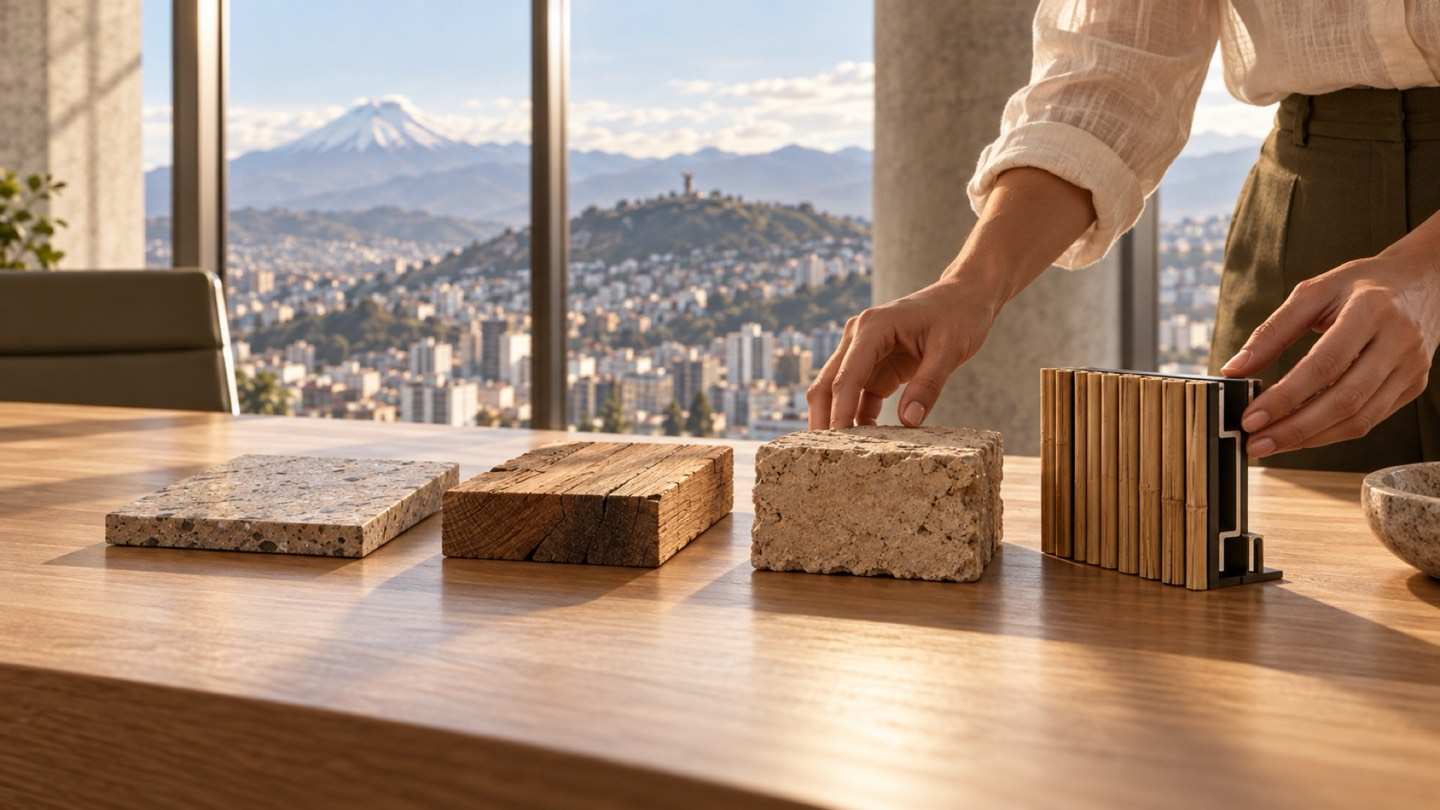
We review floors, slabs, walls and furniture to keep or reuse everything we can.
Apply the hierarchy
Keep, reuse, low impact, demountable. We only move down a step when the one above is not possible.
Approve against seven criteria
Every new material must meet the seven criteria. If we do not know where it comes from, it stays out.
Compare each package
We rate footprint, origin, indoor air, durability and end of life. We confirm it with the supplier’s data sheet and environmental declaration.
Document
Everything goes into the Materials Passport and the indicators we measure and report.
The essentials
Keep, reuse, low impact, demountable
The hierarchy always applies in this order. Keep: retain floors, slabs and walls; microcement goes on top, with no rubble. Reuse: recover furniture, doors, light fittings and stone. Low impact: natural, local, recycled or renewable materials with low VOC. Demountable: dry joints and mechanical fixings so everything can be used again.
Seven criteria to approve a material
Nearby origin: Ecuadorian and Andean materials, less transport. Renewable or recycled, with declared content. Healthy air: low-VOC paints, adhesives and sealers. Durability: finishes that age well and are repaired in place. Demountable: dry assembly and modules. Documented: data sheet, environmental declaration or certification such as FSC or EPD. Honest: it looks like what it is.
Materials library
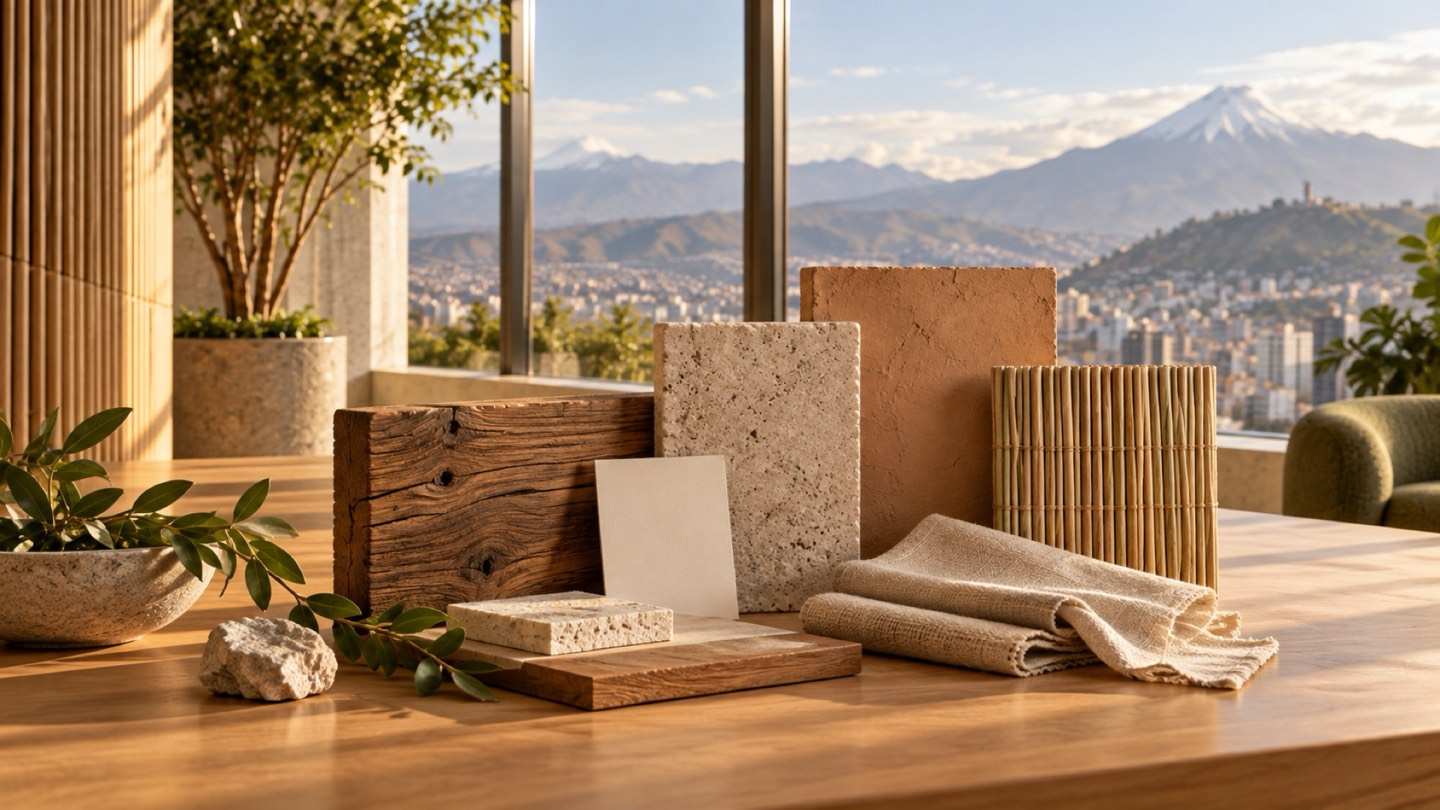
Light or graphite microcement, in 2–3 mm layers over existing surfaces. Clay plaster, which regulates humidity. Mineral lime paint, matt and breathable. Wood with forest management certification, and laminated guadúa, Ecuador’s giant bamboo. Cork, renewable without felling the tree. Local Andean stone, terrazzo with recycled aggregates and linen, wool and organic cotton textiles. Parametric totora has its own page.
Materials Passport
Every project delivers a Materials Passport. For each biomaterial it records origin, community, tests, treatments, maintenance and impact. It is the documentary proof of what was installed and of its end of life.
What we avoid
PVC vinyls and laminates that imitate wood or stone. Paints and adhesives with high-VOC solvents. Generic mineral-fibre suspended ceilings. Uncertified synthetic carpets. Artificial plants and moss. And above all, demolishing what can be kept.
What you receive
- An assessment of existing surfaces to keep.
- A material palette approved against the seven criteria.
- An evaluation sheet per finish package: footprint, origin, indoor air, durability and end of life.
- A Materials Passport covering origin, tests, treatments, maintenance and impact.
- Indicators for surfaces kept, furniture reused, national origin, low VOC and waste diverted from landfill.
Frequently asked questions
What makes an office material sustainable?
Knowing where it comes from, what it is made of and what happens to it when the space changes. It must also have a low footprint, keep the air healthy and last.
Is microcement sustainable?
Cement has its own carbon footprint. Microcement earns its place by how it is used: layers a few millimetres thick over existing surfaces, with no demolition. It is always sealed with a water-based, low-VOC sealer.
Which materials support an ESG report?
Those documented with a data sheet, an environmental declaration or a verifiable certification, such as FSC or EPD. We also measure surfaces kept, furniture reused, national origin and diverted waste.
What is the Materials Passport?
It is a sheet for each biomaterial: origin, community, tests, treatments, maintenance and impact. It is handed over at the opening, together with the Ecosystem Manual.
Do you use vinyl or porcelain tile?
We avoid PVC vinyls and laminates that imitate wood or stone. On our evaluation sheet, standard porcelain tile is flagged «review» for footprint and end of life.
Your company's performance is decided in its space.
It all starts with a Workplace Performance Audit: we measure before we give an opinion.